High vs. Low Smoke Points
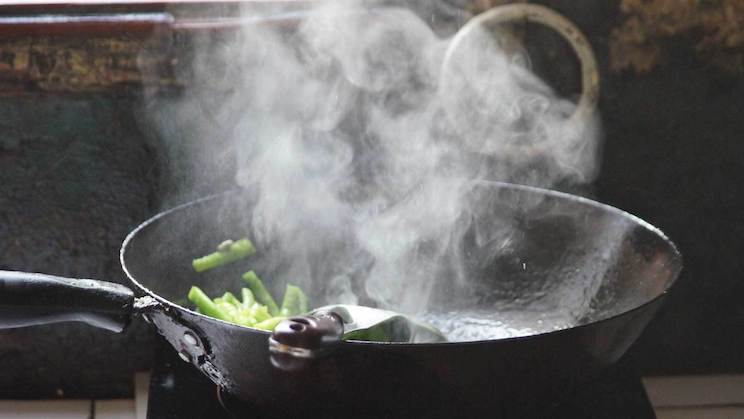
Not everyone enjoys too much smoke emitting from their pan when stir-frying or sautéing. Therefore, it is crucial to consider the smoke point of oils. Some oils are just born with a high smoke point, making them a good fit for cooking. These oils include canola oil, grape seed oil, sunflower oil, safflower oil, peanut oil, avocado oil, and coconut oil. On the other hand, flaxseed oil, hemp seed oil, walnut oil, and sesame seed oil should be used in low-heat cooking, marinades, salad dressing, and drizzling over a dish.
Moreover, the extraction process also plays a role in smoke points of oils. Generally speaking, refined oils have a higher smoke point than unrefined oils. That is because refined oils undergo intense mechanical and chemical processes. They are sometimes called light oil (in the sense of odor and taste) and have a longer shelf life than their unrefined counterparts. Meanwhile, unrefined oils are either cold-pressed or expeller-pressed. They are also sometimes labeled as extra virgin or virgin. Therefore, light olive oil can be used in high-heat cooking, while extra virgin or virgin olive oil is better consumed as it is.
Next: Are all oils bad for my cholesterol level?
Was this page helpful? Give us a thumbs up!